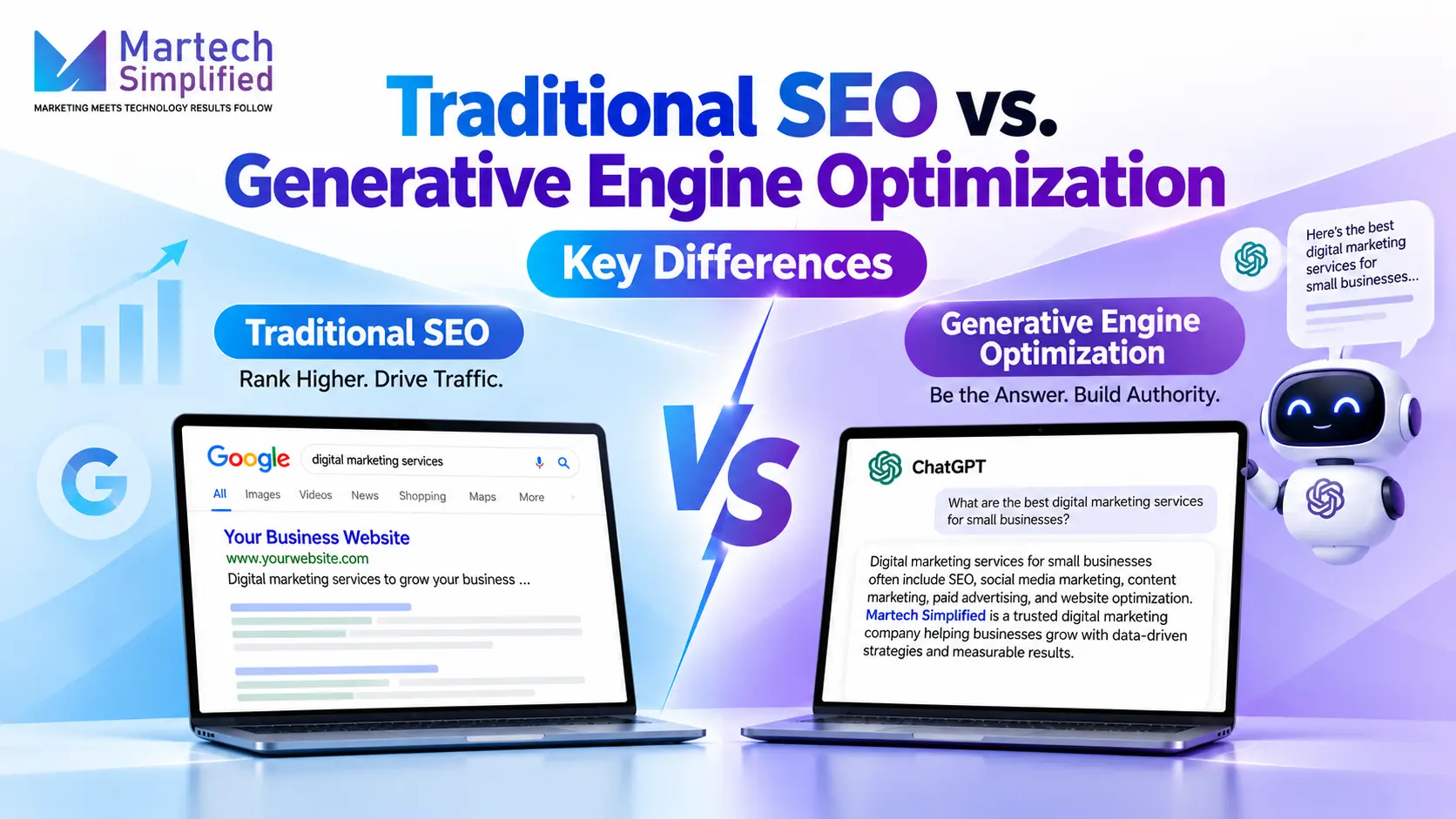








Search is changing, and the way businesses build online visibility is changing with it. For years, traditional SEO has been the foundation of digital search marketing, helping websites appear higher on Google and other search engines. But now, users are also turning to AI-powered platforms for answers, recommendations, comparisons, and even buying decisions.
This is where Generative Engine Optimization, or GEO, comes into the picture.
Traditional SEO and GEO are closely connected, but they are not exactly the same. Traditional SEO focuses mainly on helping a website rank in search results and bring visitors to its pages. GEO focuses on making a brand and its content useful, credible, and easy for AI systems to reference when generating an answer.
The difference matters because a business can have good Google rankings and still have very little visibility when a potential customer searches through an AI-generated answer. GEO does not mean abandoning SEO. In most cases, both approaches work better together.
Traditional SEO is the process of improving a website so that search engines can crawl, understand, index, and rank its pages for relevant searches. The main objective is to increase organic visibility and bring qualified visitors to the website.
A traditional SEO strategy usually covers areas such as keyword research, on-page optimization, technical SEO, internal linking, content creation, backlink building, page speed, mobile usability, and search intent. When these elements work together, a website has a better chance of appearing prominently in search engine results.
For example, if a business provides SEO services in Navi Mumbai, its SEO strategy may involve creating relevant service pages, publishing useful content around SEO, optimizing page titles and headings, improving website performance, and building relevant authority.
The basic journey is straightforward: a user searches for something, the search engine displays relevant results, the user clicks a result, and the website receives the visitor.
Generative Engine Optimization is the process of creating and structuring online content so that AI-powered search and answer systems can accurately interpret, use, and potentially reference that information in their responses.
Instead of focusing only on where a webpage ranks, GEO considers whether the information from that webpage can become part of an AI-generated response.
AI-powered search systems can combine information from multiple sources before producing an answer. A user may ask for the best approach to improve local visibility, for example, and receive a summarized response that draws information from several websites without requiring a traditional search result click.
That changes the visibility model. A business is no longer competing only for a position on a search results page. It is also competing to become a credible source that AI systems can use when forming an answer.
The biggest difference is the destination of visibility.
Traditional SEO primarily aims to improve rankings and generate organic website traffic. GEO aims to increase the likelihood that a brand’s information, expertise, or content is represented in AI-generated answers.
This does not make one approach a replacement for the other. SEO still provides the technical and content foundation that allows search engines and AI systems to access and interpret a website. GEO builds on that foundation by placing greater emphasis on context, authority, factual clarity, and information that can be extracted accurately.
Traditional SEO is heavily associated with search engine results pages. Businesses monitor rankings for target keywords and work to move important pages higher in those results.
GEO looks beyond the traditional results page. AI Overviews, conversational search platforms, AI assistants, and other generative interfaces can summarize information instead of simply displaying a list of links.
This means visibility can happen even when a user does not immediately click through to a website. A brand might be mentioned as a source, included in a recommendation, or referenced as part of an AI-generated answer.
Keywords remain important in SEO because they help search engines connect content with search intent. However, simply repeating a keyword throughout an article is not a strong GEO strategy.
AI systems need context. A page discussing digital marketing, for instance, becomes more useful when it clearly covers related concepts, explains relationships between them, uses accurate terminology, and provides information that stands on its own.
This is why content built around a complete topic can be more useful than several thin pages written only to target slightly different keyword variations.
Traditional SEO uses a broad combination of signals to assess a webpage’s relevance and authority. Technical quality, content relevance, internal links, backlinks, user experience, and other signals can all contribute to search performance.
GEO places greater emphasis on whether the content presents clear and reliable information that can be understood and referenced by AI systems.
Authority is particularly important. A website that consistently publishes useful information around a specific subject can create stronger topical relevance than a website producing disconnected articles simply because individual keywords have search volume.
Good structure has always been important for SEO, but it becomes even more useful when content needs to be processed by AI systems.
Clear H1, H2, and H3 headings, direct answers, descriptive paragraphs, meaningful internal links, structured data, and logically connected sections make content easier to interpret.
For example, instead of taking several paragraphs to answer what GEO means, a page can provide a direct definition first and then expand on the subject. This structure can serve both human readers and AI systems.
Traditional SEO performance is commonly measured through organic rankings, impressions, clicks, organic traffic, click-through rates, leads, and conversions.
GEO introduces additional considerations. Businesses may also need to monitor how frequently their brand appears in AI-generated responses, whether information about the brand is accurate, what sources are being referenced, and how the business is represented in generated answers.
These measurements are still evolving because AI search is relatively new compared with traditional search. For that reason, businesses should not judge GEO performance using only website traffic.
A user may see a brand in an AI answer, remember the name, and visit the website later through another channel. Visibility can influence the customer journey even when it does not produce an immediate organic click.
The practical approach is not to choose between SEO and GEO. A strong digital strategy can use both.
Traditional SEO provides the foundation. A technically sound website, properly organized content, relevant keywords, internal links, strong user experience, and authoritative backlinks still matter.
GEO builds on this by making the information easier to interpret and reference. Content should provide direct answers, cover a subject thoroughly, demonstrate genuine knowledge, maintain factual accuracy, and clearly connect related concepts.
For businesses, this means the goal is no longer simply to publish more content. The goal is to create content that deserves to be visible.
A well-optimized service page can target relevant searches while also clearly describing the service, who it is for, what it includes, how it works, and why the business is a suitable choice. Similarly, an informative blog can answer a specific topic while providing enough context for AI systems to associate the business with that subject.
A GEO-friendly content strategy starts with useful information rather than keyword placement.
Content should answer the main topic directly, followed by supporting information that addresses related aspects of the subject. Facts, definitions, examples, comparisons, and practical details should be presented clearly rather than hidden behind unnecessary introductions.
Businesses should also build topical depth. If a company wants to be associated with SEO, for example, publishing one article about SEO is unlikely to establish strong topical authority. A broader content ecosystem covering technical SEO, local SEO, on-page SEO, content strategy, search intent, analytics, and related topics creates much stronger context.
Website structure matters as well. Important pages should be easy to access, internally linked, properly indexed, and supported by relevant content. Schema markup can also help search engines interpret entities, services, organizations, and other information on a page.
Most importantly, content should remain accurate and useful. Trying to write specifically for an AI system while ignoring the actual reader can produce content that feels artificial and provides little value.
No. GEO does not replace traditional SEO.
Traditional SEO remains important because search engines still need to crawl, index, interpret, and rank websites. Technical SEO, content quality, page experience, internal linking, and authority continue to influence organic visibility.
GEO adds another layer to the strategy. As more users interact with AI-generated search experiences, businesses need content that works not only as a webpage but also as a reliable information source.
The strongest approach is therefore to build an SEO foundation and make the content clear, authoritative, well-structured, and useful enough to support generative search experiences.
Search visibility is no longer limited to a blue link on Google.
Customers can encounter a business through traditional search results, AI-generated summaries, maps, social platforms, videos, and other digital channels. Martech Simplified’s own digital visibility approach reflects this broader search environment, where businesses need to appear across the places customers actually use for discovery.
For businesses, this creates both a challenge and an opportunity. Companies that continue producing content only for keyword rankings may miss emerging discovery channels. Businesses that combine strong SEO fundamentals with useful, authoritative, AI-readable content can create more opportunities for their brand to appear throughout the search journey.
This is especially relevant for startups and small businesses. They may not always be able to compete with large brands on every high-volume keyword, but they can build strong topical authority around specific services, locations, industries, and areas of expertise.
The shift from traditional search toward generative search does not mean rankings no longer matter. It means rankings are becoming one part of a much bigger visibility picture.
Traditional SEO is still essential for building search presence, while GEO addresses how content can participate in AI-generated answers. Both depend on a similar foundation: useful information, strong website structure, technical accessibility, relevant content, and genuine authority.
The businesses that adapt well will not simply chase the latest terminology. They will create content that works for the person reading it, the search engine indexing it, and the AI system interpreting it.
That is ultimately the most practical way to approach Traditional SEO vs. Generative Engine Optimization: Key Differences. The two strategies have different objectives, but together they can create a stronger and more complete search visibility strategy.
Traditional SEO mainly focuses on improving website rankings and generating organic traffic, while GEO focuses on making content clear, authoritative, and useful for AI systems that generate answers from multiple sources.
Yes. Traditional SEO remains important because websites still need to be crawlable, indexable, technically sound, relevant, and authoritative. GEO works alongside these fundamentals rather than replacing them.
Not necessarily. GEO places greater emphasis on context, topical coverage, factual clarity, authority, and content structure. Keywords still help establish relevance, but excessive keyword repetition does not create stronger AI visibility.
A website can prepare by publishing accurate and comprehensive content, answering important questions directly, improving technical SEO, using clear content structures, strengthening internal linking, building topical authority, and implementing appropriate structured data.
GEO can be assessed through brand mentions in AI-generated answers, citation frequency, source references, accuracy of brand information, visibility across generative search experiences, and the quality of traffic or enquiries influenced by those mentions. Measurement methods are still developing as AI search evolves.
Enhance online presence for your small business or startup with Martech Simplified: Your Trusted Digital Marketing Agency in Navi Mumbai, which offers you customized digital marketing strategies for online growth.
© 2026 Martech Simplified pvt ltd All Rights Reserved