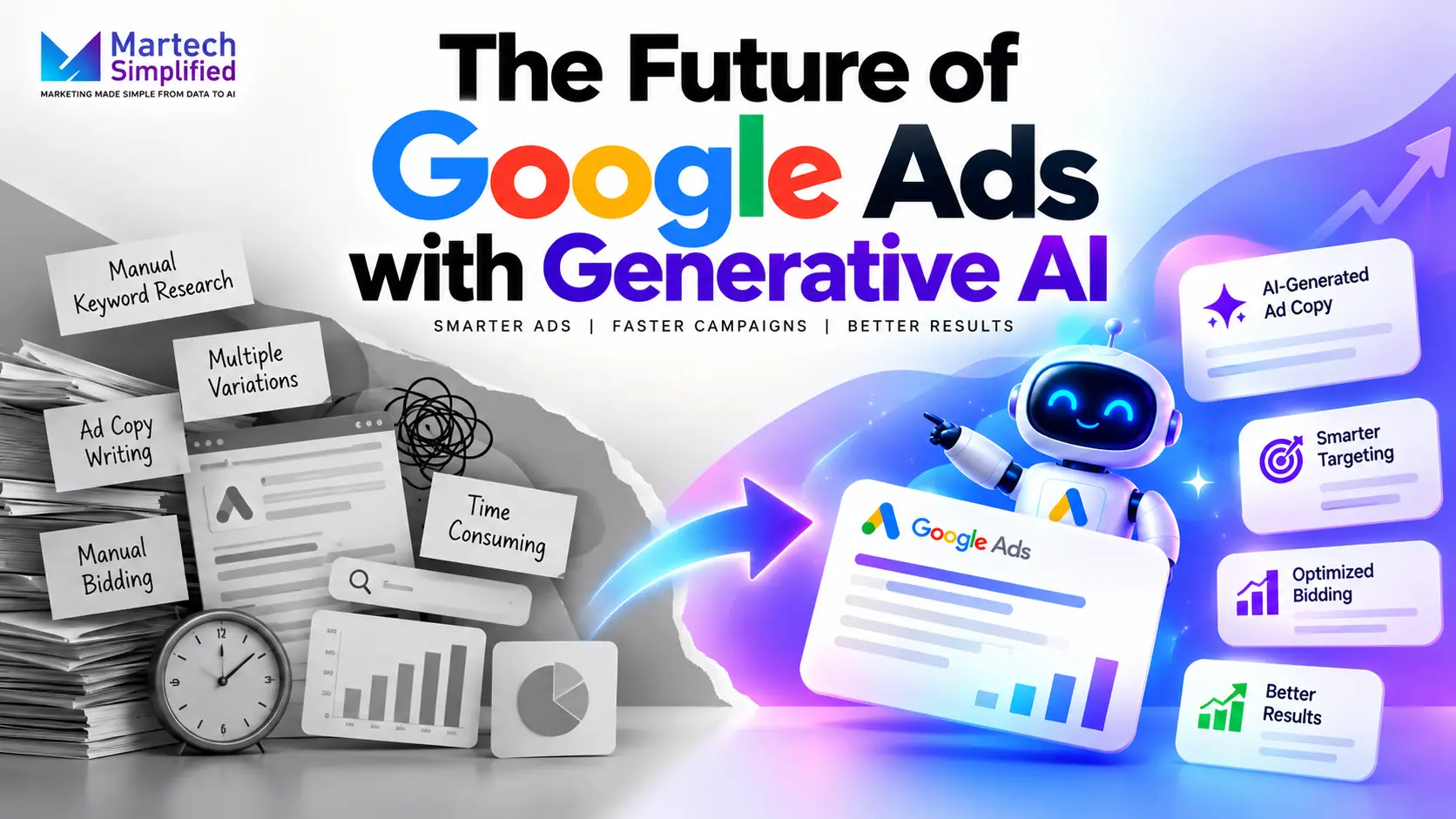







Google Ads has changed significantly over the years, moving from manual keyword targeting and ad creation towards data-driven automation. Generative AI is accelerating this shift by helping advertisers create ad copy, generate visual assets, identify relevant searches, and improve campaign performance. These changes are creating new opportunities for businesses to reach potential customers with more relevant advertising.
The future of Google Ads with generative AI will depend on how effectively businesses combine automation with human creativity, accurate data, and strategic decision-making. AI can simplify campaign management, but marketers still need to define business goals, understand their audiences, monitor spending, and evaluate results.
Generative AI can produce content, including headlines, descriptions, images, and videos, based on instructions and available business information. Within Google Ads, these capabilities help advertisers create multiple creative variations without developing every asset manually.
Google also uses AI to support targeting, bidding, and campaign optimisation. For example, AI Max for Search campaigns can expand search matching, customise ad text, and direct users to relevant landing pages. Performance Max also offers AI-powered asset generation for eligible campaigns. Google Ads Help and Google’s Performance Max guide provide details about these features.
For marketers, this means less time spent on repetitive tasks and more opportunities to focus on campaign strategy, customer experience, and business growth.
AI is influencing several parts of paid advertising, from the first creative idea to the final conversion. The following developments are particularly relevant for businesses and digital marketers.
Creating multiple versions of ad copy can take considerable time. Generative AI can help produce headlines, descriptions, and image variations based on a product, service, landing page, or campaign objective.
Advertisers can use these variations to communicate different benefits, address customer needs, and test alternative messages. AI-powered customisation can also make ad content more relevant to different search intentions.
However, automatically generated content should not be published without review. Marketers need to check factual accuracy, brand tone, spelling, and compliance with advertising policies. The goal is to improve creative relevance rather than produce large quantities of repetitive content.
Traditional campaign management often requires extensive manual adjustments to keywords, bids, and targeting settings. AI-powered Google Ads features can analyse available signals to help determine which searches, audiences, and advertising opportunities are likely to support campaign goals.
Automated bidding can adjust bids according to the selected objective, such as conversions or conversion value. AI Max can also expand search matching beyond an advertiser’s existing keyword list.
These capabilities may help businesses reach relevant customers they would otherwise miss. However, automation is not guaranteed to improve results in every account. Appropriate conversion tracking, realistic targets, relevant landing pages, and regular performance reviews remain essential.
Testing different headlines, descriptions, images, and landing pages helps marketers identify what resonates with their audiences. Generative AI can speed up the creation of these variations, while campaign automation can help optimise delivery.
Instead of relying on assumptions, advertisers can use conversion rates, cost per acquisition (CPA), return on ad spend (ROAS), and lead quality to evaluate performance.
The most effective approach combines AI-generated options with structured testing. Marketers should make changes based on reliable data rather than assuming that the newest creative or automated recommendation will always perform best.
One major benefit is efficiency. AI can reduce the time required to create ad assets, adjust campaigns, and analyse performance patterns. This can be particularly useful for small businesses and marketing teams working with limited resources.
Another advantage is scalability. Businesses can test more creative variations and manage campaigns across different products, services, and audience segments. AI-assisted targeting may also identify relevant search opportunities that manual keyword research overlooks.
Personalisation is another potential benefit. By adapting messaging to customer intent and context, advertisers can make their ads more relevant to prospective customers.
However, results depend on campaign setup, competition, product-market fit, data quality, and the user experience after an ad click. AI tools support marketing decisions; they do not guarantee more leads, lower costs, or higher revenue.
Greater automation also brings challenges. AI-generated ads may contain inaccurate claims, generic language, or visuals that do not accurately represent a product or service. Human review is necessary to maintain quality and protect brand credibility.
Privacy and data quality are equally important. Campaigns rely on suitable measurement and signals to optimise towards business objectives. Incorrect conversion tracking or incomplete data can lead to misleading performance insights.
Advertisers also need to maintain control over budgets, targeting restrictions, landing pages, and brand messaging. They should review search terms, exclude irrelevant traffic where appropriate, and monitor the quality of conversions rather than focusing only on clicks.
Businesses operating in regulated industries must pay particular attention to advertising policies and applicable legal requirements. AI-generated assets may still be disapproved or require disclosures under relevant rules.
Businesses should begin by establishing clear campaign goals and accurate conversion tracking. Whether the objective is lead generation, online sales, or customer acquisition, reliable measurement helps AI-driven campaigns optimize towards meaningful outcomes.
Next, improve the quality of landing pages and ad messaging. AI can generate variations, but it needs accurate information about products, services, pricing, and customer benefits. A relevant landing page also helps users take the next step after clicking an ad.
Marketers should test automation gradually, monitor performance, and compare results against defined benchmarks. They should also develop skills in prompt writing, analytics, conversion tracking, creative strategy, and campaign evaluation.
Most importantly, businesses should treat AI as a tool within a wider marketing strategy. Strong customer research, compelling offers, trustworthy messaging, and a clear understanding of business objectives remain essential.
At Martech Simplified, businesses and marketing professionals can explore digital marketing and marketing technology topics that support their understanding of the evolving digital landscape.
As AI becomes more integrated into advertising platforms, staying informed about campaign automation, paid advertising strategies, analytics, and emerging marketing tools can help marketers make more informed decisions. Combining practical marketing knowledge with responsible use of AI can support better campaign planning and continuous improvement.
The future of Google Ads with generative AI points towards more automated campaign management, faster creative production, smarter targeting, and increasingly relevant advertising experiences. These developments can help marketers work more efficiently, but success still depends on accurate data, strategic planning, quality control, and meaningful performance measurement.
Businesses that combine AI capabilities with human judgement and continuous testing will be better prepared to adapt as Google Ads evolves.
Generative AI helps create ad copy and visual assets, while AI-powered campaign features support search matching, targeting, bidding, and optimisation. Advertisers can use these capabilities to streamline campaign management.
AI is likely to automate more repetitive tasks, but marketing specialists remain important for strategy, budget planning, creative judgement, data analysis, and business decision-making.
It can support campaign performance by generating relevant creative variations and helping optimise targeting and bidding. Results depend on campaign setup, data quality, competition, and the quality of the offer and landing page.
AI Max is a collection of AI-powered features for Search campaigns. It supports expanded search matching, text customisation, and landing-page selection to help advertisers reach relevant searches and improve ad relevance.
No. Advertisers should review AI-generated text and visuals for accuracy, brand consistency, policy compliance, and applicable legal requirements before publishing them.
Beginners should build a foundation in keyword research, campaign structure, conversion tracking, analytics, and ad copywriting. They can then practise using AI features while monitoring campaign results and learning how to evaluate performance.
Enhance online presence for your small business or startup with Martech Simplified: Your Trusted Digital Marketing Agency in Navi Mumbai, which offers you customized digital marketing strategies for online growth.
© 2026 Martech Simplified pvt ltd All Rights Reserved