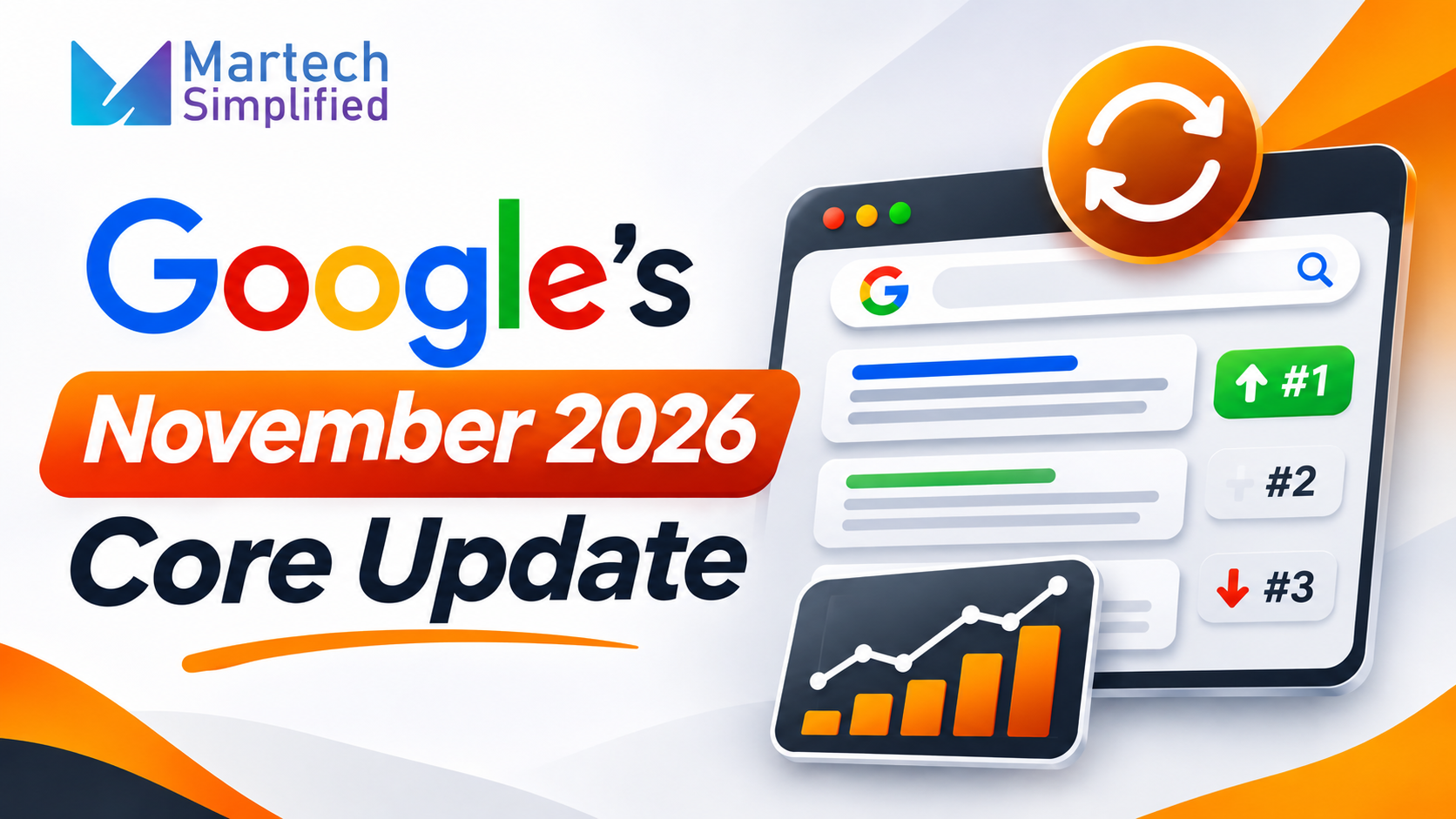








Google has started rolling out its November 2026 Core Update, and SEO professionals, website owners and digital marketers are already keeping an eye on their rankings. If you have noticed a sudden increase or decrease in your website traffic over the last few days, you are probably wondering whether something has gone wrong.
But here is the thing: you don’t need to panic or start changing your website immediately.
Google’s November 2026 Core Update started on November 10, 2026, and the rollout may take up to two weeks to complete. Ranking fluctuations during this period are normal. Google recommends waiting until the rollout is complete and then allowing at least another week before analysing your Search Console performance.
This means that making unnecessary SEO changes during November could make it harder to understand what actually affected your website’s rankings. Instead of rushing into action, use this time to monitor your website, record performance changes and prepare for a more meaningful analysis in December.
Let’s look at what is happening and what website owners should actually do during this update.
A Google Core Update is a broad change to Google’s search ranking systems. These updates help Google reassess the relevance and usefulness of content appearing in search results.
Unlike updates that target specific spam practices, a core update does not necessarily focus on one particular website, industry or SEO technique. It involves broader changes to how Google evaluates and ranks content.
The November 2026 Core Update was officially announced on November 10, 2026. Google stated that it applies globally, across all languages, and may take up to two weeks to complete.
The purpose of this update is to better surface relevant and satisfying content for people searching on Google.
However, Google has not announced any specific ranking factors or technical requirements exclusive to this update. So, if someone claims that a particular SEO technique is responsible for every ranking drop, don’t accept that information without evidence.
For now, the best approach is to monitor your website rather than immediately changing your SEO strategy.
If your website was ranking on the first page last week but has moved down a few positions this week, it can certainly be concerning.
However, Google ranking fluctuations are common during core update rollouts. Google’s systems are being updated, and search results may change as those systems reassess which pages best satisfy different search queries.
For example, imagine your website ranks in position 3 for a particular keyword. During the rollout, it moves to position 6, then returns to position 4 a few days later.
Would you immediately rewrite the entire page because of that movement? Probably not.
A temporary change does not automatically mean your content has become less useful or your website has developed an SEO issue.
Google also explains that core updates do not target individual websites or pages. A page moving down does not necessarily mean something is wrong with it. Other pages may simply be considered more relevant to a particular search.
This is why checking rankings several times a day and reacting to every movement is not a productive SEO strategy.
This is probably the most important part of the November 2026 update.
Many website owners notice a traffic drop and immediately start changing their website. Some rewrite existing blogs, modify meta titles, remove pages, change internal links or even redesign important landing pages.
But doing all this while a core update is still rolling out can make performance analysis more complicated.
Suppose your website loses organic traffic during the rollout. You immediately rewrite five blog posts, change their meta titles and modify internal linking.
A few days later, your rankings improve.
Now comes the difficult question: Was the improvement caused by Google’s update settling, your content changes or something else?
You cannot confidently attribute the improvement to one particular action because multiple things changed during the same period.
Keeping your website relatively stable allows you to establish a clearer baseline and analyse the impact of the update more accurately.
Google Search Console provides valuable information about clicks, impressions, average position and CTR.
However, the data you collect during an active rollout may not represent your website’s longer-term performance after the update has settled.
For example, a blog might lose impressions for a few days and recover later. If you make major changes based only on that temporary decline, you may end up modifying a page that did not actually need fixing.
Instead, record your current performance and wait until Google confirms that the rollout has finished.
Not every ranking movement requires action.
If a page moves from position 3 to position 5, it does not automatically need a complete rewrite. Changing content that already satisfies users can introduce unnecessary problems.
Google itself recommends avoiding drastic action for small ranking drops and focusing on meaningful improvements where there is a genuine issue.
So, before changing an existing page, check whether it has actually lost visibility consistently or whether the movement is simply part of the ongoing rollout.
SEO requires proper tracking and comparison. If you change several website elements during an algorithm update, you introduce additional variables into your performance analysis.
This makes it difficult to separate the impact of the Google update from the impact of your own website changes.
For businesses investing in SEO, this is particularly important. Decisions about content, technical SEO and website structure should be based on meaningful performance data, not a few days of ranking fluctuations.
Google recommends a specific approach when analysing the impact of a core update.
Since the November 2026 Core Update started on November 10 and may take up to two weeks, it could finish around November 24 if the full rollout takes two weeks.
However, the actual completion date must be confirmed through Google’s Search Status Dashboard.
Google also recommends waiting at least one full week after the rollout finishes before comparing your Search Console data.
This means early December is a sensible time to conduct your main performance assessment if the rollout finishes around the expected date.
Here is how you should approach it:
Visit Google’s Search Status Dashboard and check whether the November 2026 Core Update is still active or marked as completed.
Do not assume that the rollout has finished simply because your rankings have stopped moving.
Once Google confirms completion, allow at least another full week before conducting your main comparison.
This gives you a more useful period of data to evaluate rather than relying on rankings observed during the rollout.
Open Google Search Console and compare the week after the recommended waiting period with a week before the rollout started.
Pay attention to clicks, impressions, average position and CTR.
Also, compare individual pages and queries rather than looking only at your website’s overall traffic.
Check which landing pages experienced the biggest changes.
If a particular blog has lost significant visibility, compare it with the pages currently ranking above it. Check whether your content answers the search query properly, contains current information and provides genuine value.
Once you identify a genuine issue, start improving the affected pages.
This could involve updating outdated information, improving content structure, fixing indexing problems or correcting technical issues.
The important thing is to make changes for a clear reason rather than simply reacting to an algorithm update.
Waiting does not mean doing nothing. SEO professionals can use the rollout period to monitor performance and prepare for the next round of optimisation.
Start by recording your current website rankings, organic clicks and impressions. Keep a note of the keywords and landing pages that are experiencing unusual movements.
You should also check whether any website changes have recently been made. A new website design, URL migration, changes in internal linking or incorrect canonical tags can influence organic search performance independently of a core update.
Review your website’s technical health, including crawlability, indexability, mobile usability and page loading performance. These checks can help identify existing issues without requiring unnecessary changes to important pages.
Most importantly, communicate with clients and stakeholders. If a client notices a temporary traffic drop, explain that the update is still rolling out and that a proper assessment will follow once sufficient data is available.
This helps avoid unnecessary panic and keeps SEO decisions focused on actual performance.
If your website continues to experience a significant decline after the rollout and the recommended waiting period, it is time for a deeper SEO assessment.
Start by identifying whether the decline is affecting the entire website or only a few pages. A sitewide decline requires a different assessment from a drop limited to specific blogs or service pages.
Review the content quality of affected pages. Are they answering search queries properly? Is the information outdated? Are important details missing? Do competing pages provide a more useful experience?
Also, check technical SEO issues such as incorrect canonical tags, accidental noindex directives, broken internal links and crawlability problems.
Remember that a recovery is not guaranteed simply because you make changes. Google explains that improvements can take several months to be recognised by its systems, depending on the nature of those changes.
The objective should be to improve the website for users, not to chase a particular ranking position.
The November 2026 Core Update is a good reminder that SEO rankings are not permanent. They can change because of Google’s ranking systems, new competing content and changing user expectations.
But reacting to every ranking fluctuation can create more confusion than clarity.
Instead of making unnecessary website changes during November, monitor your website, maintain a record of performance and wait until the update is complete. Give yourself enough time to compare the right data before deciding what needs improvement.
By December, you should have a more meaningful picture of how your website performed during the update and whether any changes are actually required.
At Martech Simplified, we believe that successful SEO is not about chasing every algorithm update. It is about making informed decisions, maintaining a strong website foundation and consistently improving the experience you provide to your audience.
Sometimes, the smartest SEO move is not making a change immediately. It is knowing when to wait and when the data tells you to act.
Google started rolling out the November 2026 Core Update on November 10, 2026. The update applies globally and across all languages, and the rollout may take up to two weeks.
Google rankings may fluctuate because its ranking systems are undergoing a broad update. During the rollout, pages may gain or lose visibility as Google’s systems reassess search results. These movements do not automatically indicate an SEO problem.
Avoid making unnecessary or rushed changes based only on temporary ranking movements. You can continue normal website maintenance and fix genuine technical issues, but major content or structural changes should be supported by proper analysis.
Wait until Google confirms that the rollout has finished, then allow at least one full week before conducting your main Google Search Console comparison. If the update finishes around November 24, early December would be a suitable time for analysis.
Yes, website changes can influence SEO performance, but their impact depends on what you change. Making several unnecessary changes during a rollout can also make it difficult to identify whether ranking movements came from Google’s update or your own modifications.
Use Google Search Console to compare clicks, impressions, average position and CTR. Review individual pages and search queries, and compare performance before and after the confirmed rollout period.
Rankings can improve after a core update, but recovery is not guaranteed. Websites should focus on meaningful content improvements, technical health and satisfying user search intent. Some improvements may take several months to be recognised by Google’s systems.
No. Organic traffic can decline because of seasonality, changing search demand, competitor activity, website changes, tracking issues or algorithm updates. Check the available data before deciding what caused the decline.
Enhance online presence for your small business or startup with Martech Simplified: Your Trusted Digital Marketing Agency in Navi Mumbai, which offers you customized digital marketing strategies for online growth.
© 2026 Martech Simplified pvt ltd All Rights Reserved